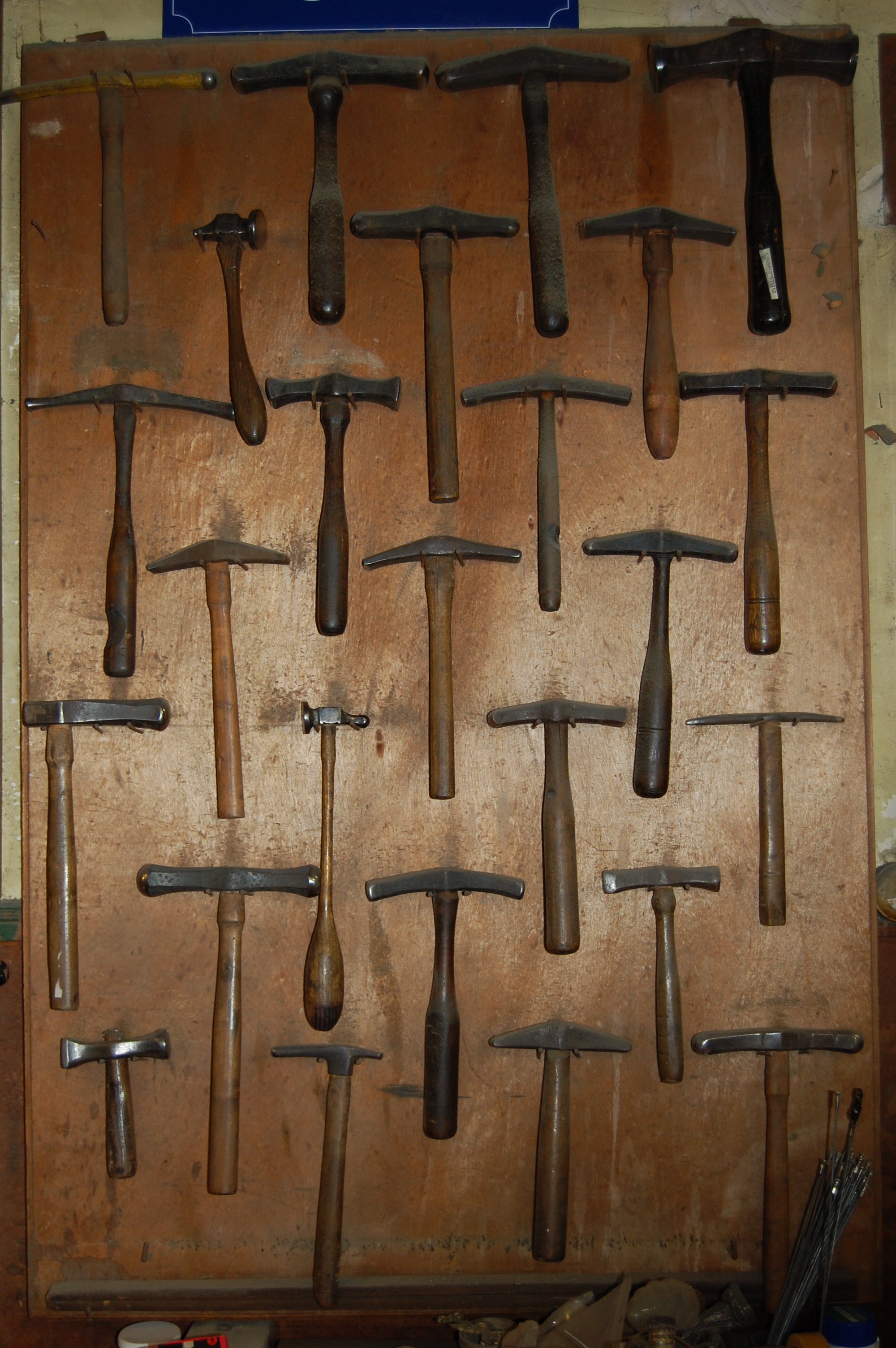
The workshop occupies one corner of the ground floor of a former cutlery factory on Effingham Road in Sheffield's Attercliffe district. The building was built in 1894, abandoned in 1981, and converted into small studios in 2007. Oonagh Tindall took her unit in 2012.
She trained at the Sheffield Assay Office and then under Brian Asquith in the late 1990s, before Asquith retired. She has worked as an independent silversmith and restorer for twenty-four years and has held a maker's mark, OT, since 2002.
Her workshop has a brick floor, a stamped tin ceiling, and two long workbenches set against the south wall under a row of casement windows. The windows have not been opened in years; she has fitted them with permanent extraction hoods over the soldering stations.
On the Friday in question, the twenty-second of May, she is repairing a four-piece tea service made by Walker and Hall of Sheffield in 1908. The service belongs to a family in Eccleshall and has been in continuous use, with diminishing frequency, since it was a wedding gift to a great-great-aunt in 1909.
The teapot has a damaged spout — the casting at the tip has split along a hairline crack and the engraved monogram on the body has worn through where decades of polishing cloths have caught its high points. The milk jug has a loose handle. The sugar bowl is missing one of its four feet.
Tindall photographs each piece on a sheet of black velvet under raked light before she begins. The photographs go into a manila folder labelled with the client's surname and the year. She has a filing cabinet of these folders going back to 2003.
She begins with the teapot spout. The crack is too fine to braze without first opening it slightly with a jeweller's saw, removing any oxidised metal at the edge, and preparing the surfaces for solder.
She uses a hard silver solder — Easy-flo Hallmark, a Cookson product — applied with a small propane-and-oxygen torch fed from a single mixed-gas cylinder she keeps under the bench. The solder runs at around six hundred degrees Celsius and bonds chemically to the silver without changing its hallmark status.
The repair is done in three passes. She tacks the join, checks the alignment under a binocular microscope mounted to a swing-arm above the bench, and only then floods the join with solder. The microscope was bought used from a retired dental technician in Rotherham in 2014.
When the solder has cooled, she files the join flush with a fine cut Vallorbe file, then works through five grades of silicon carbide paper from 600 to 4000 grit. The final polish is done on a felt mop with rouge, run at low speed on a Foredom rotary tool.
The monogram on the body of the teapot — an interlaced E and W for the great-great-aunt's married name — is more delicate work. Tindall has consulted the family about whether to recut the engraving or leave the worn version as honest evidence of use.
They have asked her to recut. She has agreed on the condition that she document the original with rubbings and photographs first, which she does at her bench using black graphite and onion-skin paper. The rubbings go into the family's folder.
Recutting is done freehand with a graver, a small steel tool with a square-ground tip held in the palm of her right hand and pushed against the silver with the heel of her thumb. She wears an Optivisor with a 3.5X lens and works at a slight angle for two and a half hours.
She breaks for tea at eleven and again at three. The kettle is an electric one she has owned since the workshop opened. The tea is plain Yorkshire from a tin she keeps in the drawer with the gravers.
The milk jug's handle is reattached with a low-temperature silver solder so that the hard solder of the original construction does not melt out. This is the kind of distinction the trade calls a step soldering operation, and it is the sort of thing that separates a silversmith from a jeweller in the practical sense.
The sugar bowl's missing foot is the largest job. Tindall has obtained a small ingot of sterling silver from a supplier in Hatton Garden and will cast the replacement foot from a sand mould taken off one of the three surviving feet. The casting itself will be done on Saturday morning.
The Walker and Hall hallmarks on each piece are clear: the lion passant for sterling, the crown for Sheffield, the date letter for 1908, the maker's mark W&H Ltd in a rectangular punch. She does not add her own restorer's mark to the work, which is a personal policy. The hallmarks belong to the original maker, she says.
By five in the afternoon the teapot is finished, the milk jug's handle is set, and the sugar bowl is awaiting its new foot. The pieces sit on a felt-lined tray at the back of the bench, covered with a length of acid-free tissue.
She locks the workshop at six and walks to Attercliffe station to catch the tram into the city centre. The factory building is quiet behind her. The other studios are dark. She has, she says, no plans for the evening that cannot be cancelled.