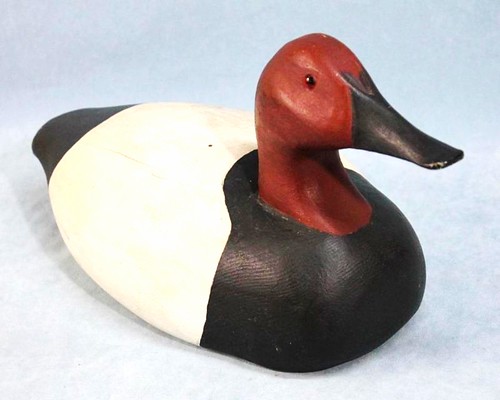
The shed sits behind a 1907 frame house on Bourbon Street in Havre de Grace, Maryland, two blocks from the Susquehanna Flats. Walter Brimm bought the house in 1989 and converted the shed from a coal store into a carving and restoration shop the same year.
He has been restoring working decoys — the wooden gunning birds carved on the upper Chesapeake from the late nineteenth century until commercial waterfowling collapsed in the 1930s — for thirty-seven years. He carves new birds occasionally, but the bulk of his work is conservation of older pieces.
On the morning in question, the second of June, he is at his bench refinishing a pintail drake carved by R. Madison Mitchell of Havre de Grace in 1936. Mitchell, who died in 1993, was the most prolific decoy maker of the Chesapeake region and carved an estimated 100,000 birds across a sixty-year career.
The pintail belongs to a collector in Easton who bought it at the Easton Waterfowl Festival in November 2024. The bird had been overpainted at some point in the 1970s in a thick layer of latex house paint, which has cracked and yellowed and obscures the original Mitchell paint scheme underneath.
Brimm's job is to remove the latex without disturbing the original paint. This is delicate work and is the kind of restoration that takes the better part of a month to do properly. He charges by the hour for it, plus materials.
He works under a single fluorescent fixture and a goose-neck lamp at a bench he made from yellow pine in 1991. The bench has a vise at one end that he padded with chamois leather so that decoys can be clamped without bruising.
The shed smells of mineral spirits and balsa wood. There is a wood stove in the corner, unlit in June, and a coffee maker on a side table beside a stack of issues of the magazine Decoy Hunter from the 1980s.
Latex removal begins with a localised test. Brimm applies a small amount of a methylene chloride paint remover to a hidden area of the decoy with a cotton swab and waits ten minutes. The latex softens. The original oil paint beneath, fortunately, is unaffected.
He works in patches no larger than a square inch. The softened latex is lifted with a hardwood scraper he ground from a piece of dogwood, which is soft enough that it will not scratch the underlying paint. He cleans the scraper with a rag and a fresh dip of solvent every few minutes.
The Mitchell paint scheme emerges gradually. The drake's head is a chocolate brown with a white stripe up the side of the neck. The breast is white with fine pencilled barring. The back is grey with the characteristic vermiculation Mitchell painted in slow, even strokes with a fine sable brush.
Brimm has studied Mitchell's paint technique for decades. He has, in his files, photographs of more than two hundred documented Mitchell birds, organised by year and species. He uses the file as a reference whenever he is uncertain whether a particular detail is original or restored.
He breaks for coffee at ten. The coffee is from a green can of Eight O'Clock and is drunk black from a ceramic mug with a print of a canvasback drake. The mug was a gift from his wife in 2004. She died in 2019. He has not replaced the mug.
His daughter Margaret lives in Annapolis and calls most Sundays. She has, he says, no interest in the decoy trade, which is fine with him. He does not want it to become an obligation she has to manage after he is gone.
By noon the head and neck of the pintail are clean. The body will take another two days. He covers the bird with a clean cotton cloth and switches off the lamp.
After lunch — a turkey sandwich at the small marina café three blocks away — he returns to the shed and turns to a different bird, a black duck by Sam Barnes of Havre de Grace, dated by hardware to about 1900, that needs only a structural repair to the keel.
The keel is the lead weight nailed to the underside of a working decoy to keep it riding upright in the water. The Barnes keel has come loose, and the nails are rusted. Brimm removes them with a small claw, replaces them with copper nails of the original style, and reseats the keel with a thin bedding of marine sealant.
He logs each job in a hardback ledger he has kept since 1989. The entries are short: bird, carver, date, owner, work performed, hours, materials cost. He has filled four ledgers. The fifth is about a third full.
By four in the afternoon he is finished for the day. He walks down to the promenade by the lighthouse and watches a flight of cormorants come in over the Flats. He does not carry binoculars. He has, he says, seen enough birds in his life that he does not need to count them.
The collector from Easton is patient. He has told Brimm to take whatever time he needs and to call when the bird is ready. Brimm will call in early July, when the pintail is back in its 1936 paint and ready to go home.