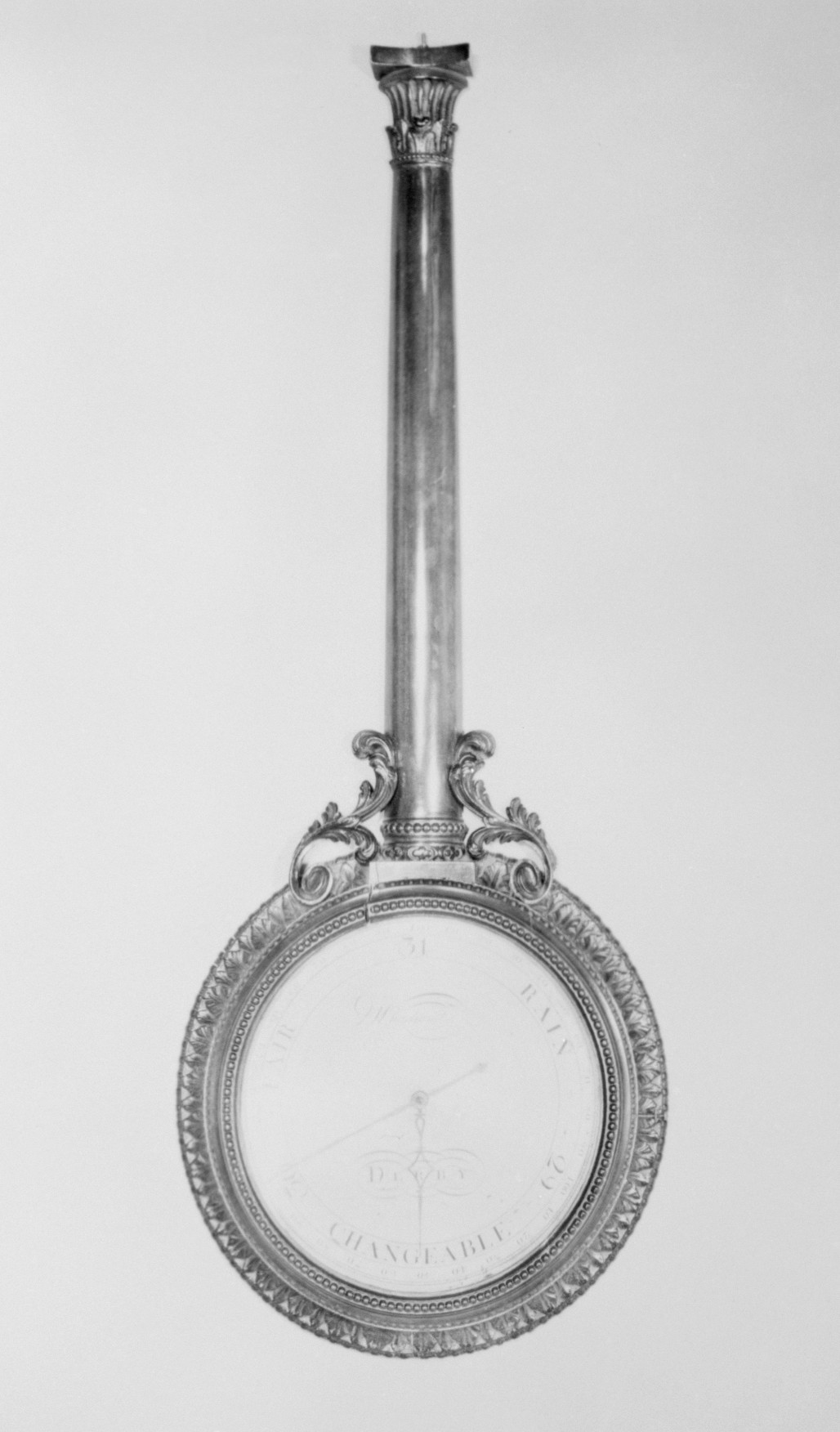
The workshop is a stone building that was a dairy until 1962, set behind a private house on a single-track lane two miles west of Stow-on-the-Wold. Cedric Halsall has rented it from the same family for twenty-six years and has never had a written lease.
He restores barometers — mainly mercury stick barometers, occasionally wheel barometers, very occasionally aneroids. The trade is small. He estimates there are fewer than a dozen people in the British Isles who do the work he does at the level he does it.
On the morning in question, the twenty-first of May, he is refitting the cistern on a stick barometer made by Negretti and Zambra of Holborn, London, in 1881. The instrument belongs to a family in Burford and has been in their possession since at least the 1920s.
The barometer arrived in a wooden crate Halsall built specifically for transport — barometers travel badly because the mercury column is sensitive to shock, and the original cistern is a fragile leather-and-boxwood assembly that does not tolerate being inverted.
He receives the instruments by his own collection wherever he can. He drives a 2011 Volvo estate with a custom rack in the back that holds two barometer crates in upright position. He does not let couriers handle the work.
The Negretti and Zambra is six feet two inches tall, with a rosewood case, a silvered brass scale, and a thermometer mounted to the left of the tube. The cistern at the base is the original boxwood, with a leather diaphragm at the bottom that was used to compensate for changes in mercury level during transport.
The leather has perished. Halsall expected this. He has a sheet of period-appropriate goatskin in a drawer that he has been saving for the right job. He cuts a disc to fit the cistern with a pair of brass shears and stretches it gently over the cistern bottom while the glue cures.
Mercury work is done in the back of the workshop, behind a sheet of polycarbonate fitted with a small extraction fan. Halsall wears nitrile gloves and a half-face respirator with mercury-rated cartridges. He has had his blood mercury level tested annually since 2003. It has never been elevated.
He pours the mercury from a sealed glass reservoir into a small porcelain dish through a clean cotton filter. The mercury is reused from his own stock — he buys it in five-kilogram lots from a single supplier in Switzerland and reclaims it from every barometer he services.
Filling the tube requires patience and a precise tilt. The tube is upended into the mercury bath, sealed at the top end with a thumb, lowered into the cistern, and the thumb is released only when the bottom end is submerged. Air bubbles ruin the column.
Halsall has filled, by his own count, somewhere around fourteen hundred tubes in his career. He has lost three to bubbles in the past decade. He does not consider that a bad rate, but he aims for zero.
The Negretti and Zambra is calibrated to read in inches of mercury, from 26 to 31, in tenths and hundredths. The silvered scale is original and has tarnished slightly along its lower edge. Halsall cleans it with a paste of jeweller's rouge and distilled water applied with a chamois.
He breaks for coffee at eleven. The coffee is filter, made in a Melitta dripper, drunk black from a green enamel mug that belonged to his father, who was a research chemist at ICI and died in 1998.
The workshop is heated by a small wood stove in the corner, which Halsall lights only on the coldest days. Mercury behaves differently at different temperatures, and he prefers a stable working temperature of around fifteen degrees Celsius for column work.
He calibrates the refilled barometer against a Fortin barometer he keeps on the north wall, which he has maintained as his shop reference since 2001 and which is itself calibrated annually against a primary standard at the National Physical Laboratory at Teddington.
The Negretti and Zambra reads two-hundredths of an inch low at the reference pressure. Halsall adjusts the vernier by loosening two small brass screws and sliding the scale plate down by the precise amount. He retightens the screws and rechecks against the Fortin. The instrument now agrees.
By two in the afternoon the barometer is hanging from a hook on his test wall, where it will stay for a fortnight while he watches it for drift. Most instruments settle in a week. The ones that drift longer often have a slow leak at the cistern, which is the kind of fault Halsall would rather catch in his own workshop than in someone's Burford dining room.
He leaves the workshop at four and walks the lane back to the village to post a letter. The hedgerows are dense with cow parsley. A pair of jackdaws follow him for half the distance, calling intermittently from the elder bushes.
The family in Burford rings him most weeks. They have offered him tea and an early lunch when he delivers the barometer. He has accepted in advance. This part of the work, he says, is not in the bill.