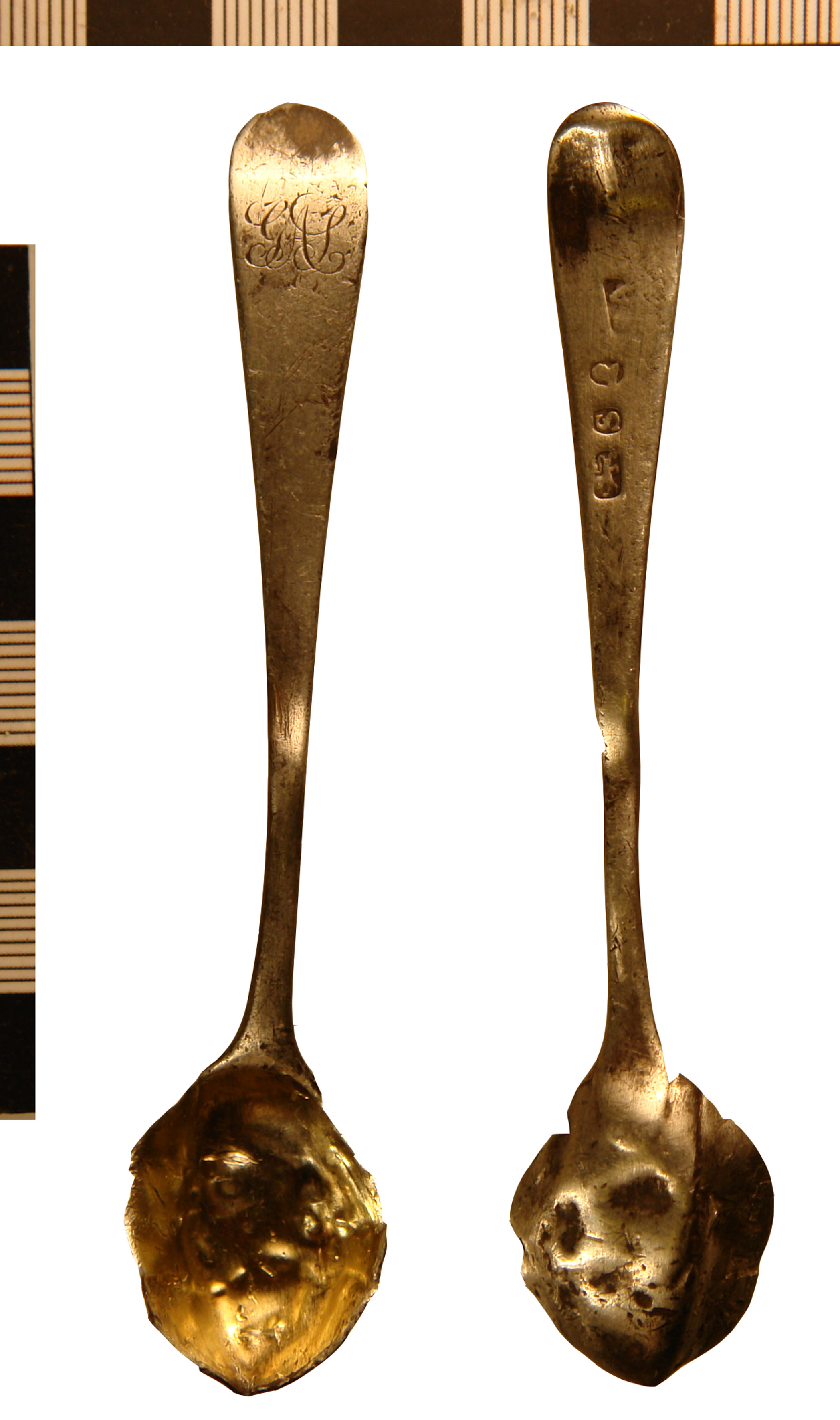
A page from the Sheffield Assay Office's 1899 ledger sits open on Cyrus Peake's bench, and the small Gothic capital P stamped beside the crown explains, by itself, why a tea caddy turned up in a Stockport house clearance last March was almost certainly bought new in the autumn of that year.
The year letter is the smallest of the four marks usually present on Sheffield silver. It is also the most useful. A maker's mark tells you who; a standard mark tells you what; a town mark tells you where. The year letter alone tells you when.
Sheffield's assay office was established in 1773, the same year as Birmingham's, by an Act of Parliament that the cutlers had pressed for over a decade. Before the Act, Sheffield silversmiths had to send their work to London or York to be tested.
The town mark for Sheffield is the crown. From 1975 onward the crown was retired in favour of a rose, but for the long stretch that interests most collectors — the late Georgian, the Victorian, the Edwardian — the crown is what you are looking for.
Year letters in Sheffield ran on a 26-letter cycle, with the typeface and case changing at each new cycle so the cycles could be told apart. The 1824 to 1843 cycle used a Roman capital; the 1844 to 1867 cycle used a small Roman; and so on.
The trick is the typeface. A Gothic capital P from the 1893 to 1903 cycle looks nothing like the sans-serif P from the cycle ending in 2000, and a competent eye can date a Sheffield piece to within a decade without consulting the tables.
Cyrus Peake apprenticed at the Sheffield assay office in 1994 under a man named Wilfred Banner, who had himself apprenticed in 1948. Banner taught him to read the marks with a loupe held at a particular angle, so the depth of the strike caught the bench light.
Depth matters. A shallow mark, almost ghosted, often means the piece was polished too aggressively at some point in its life. A clean, deep mark on an old piece usually means a careful owner.
The duty mark, the sovereign's head in profile, was added in 1784 and discontinued in 1890. Its presence narrows the date window to that 106-year span before you even look at the year letter.
George III appears in profile, facing right, from 1784 to 1820. George IV faces left. William IV faces right. Victoria, from 1837, faces left. Victoria's head was simplified in 1853 and again in 1887.
When the duty mark is absent on a piece that should otherwise carry it, two possibilities arise. The piece may post-date 1890, or it may be unmarked because it was made for export and exempt from duty.
Export pieces are a small but interesting category. A Sheffield tea service marked for export in 1882 turned up at a small auction in Halifax last autumn; the absence of the duty mark, combined with the rest of the marks, identified it within minutes.
Forgeries of Sheffield marks exist, but they are less common than collectors fear. The Sheffield mark is awkward to forge convincingly because the crown punch was a specific tool and its wear pattern over years is itself a kind of signature.
More common than outright forgery is the transposed mark — a section of marked silver cut from a damaged piece and let into an unmarked piece. Under raking light, the let-in patch is almost always visible as a thin discontinuity.
The standard mark, a lion passant, certifies the silver as sterling — at least 92.5 percent silver by weight. A Britannia mark, used briefly between 1697 and 1720 and intermittently after, certifies a higher standard of 95.8 percent.
Maker's marks are the most personal of the four. They are also the most variable. Some makers used initials, some used a symbol, some used both. A small heart-and-crown stamp in addition to initials almost certainly identifies the firm of Hawksworth, Eyre and Company.
Two reference books sit on the corner of Peake's bench, both broken-spined. The first is Bradbury's Book of Hallmarks, first published in 1927 and still in print. The second is Jackson's English Goldsmiths and Their Marks, third edition, 1921.
Bradbury is the better book for daily use. The tables are organised by cycle, and the typefaces of the year letters are reproduced clearly enough that a quick comparison can be made without a magnifier.
Jackson is the better book for the unusual mark. It records makers by initials and gives biographical information that often explains a piece's quality or its survival.
A small confession from the workbench: the marks do not always tell the whole story. A Sheffield candlestick from 1873, marked clearly, sat on a side table in a Manchester flat for forty years and was used as a doorstop. The marks did not protect it from the use.
What the marks do is give the next person a chance. A buyer in 2026 who can read the cycle, the duty head, and the crown is the heir to a system that has been working, with only minor modifications, for two and a half centuries.
Peake closes the 1899 ledger and reaches for another. The next piece on the bench is a small mustard pot, and the loupe goes back to the rim.
Filed under