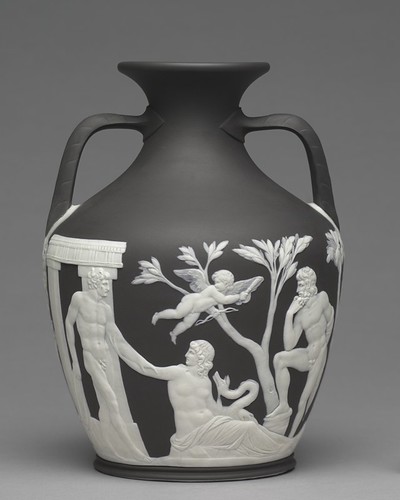
A blue jasperware vase came into Beatrix Joost's attention last May, marked on the underside with the impressed letters WED beside three smaller capitals, M, B, and F. The three letters, read in sequence, place the vase to August 1881 with no ambiguity.
Wedgwood, alone among the major Staffordshire potteries, kept a system of date marks consistent enough that a competent reader can identify the month and year of manufacture for almost any piece made between 1860 and 1929.
The system was introduced by the firm in 1860 under the management of Godfrey Wedgwood, the great-grandson of the founder. It was intended primarily for internal use — for quality control and stock-tracking — but it has become, for the collector, the most reliable dating tool in the trade.
Three impressed capital letters appear together, usually near the WEDGWOOD impressed mark. The first letter denotes the month. The second is the potter's initial — a workshop reference of no use to the modern collector. The third letter denotes the year.
Month codes ran J for January, F for February, R for March, A for April, Y for May, T for June, V for July, W for August, S for September, O for October, N for November, D for December. The R for March and the Y for May are the two that catch the inexperienced eye.
Year codes, the third letter, ran on a 26-year cycle. The first cycle, beginning in 1860, ran from O to Z, then A to N. The second cycle ran from A to Z, restarted in 1872. The third began in 1898.
A vase marked with the third letter F in 1881 cannot be confused with a vase marked with the third letter F in 1907 because the typeface and the size of the impressed letters differ between cycles. The third-cycle letters are noticeably smaller.
Beatrix Joost keeps Wedgwood's 1928 internal date-mark guide on her desk, photocopied from the original at the Wedgwood Museum at Barlaston. The guide lists, with workmanlike clarity, every month-and-year combination from 1860 forward.
The guide also notes the exceptions. The year 1907 used the letter L; the year 1908 used the letter M; the year 1909 used the letter N. But in 1909 the system was revised to a three-numeral system for some categories of pottery, and the letter codes coexisted with numerals for a transitional period.
Bone china carried its own additional mark: a small painted number on the foot rim, indicating the pattern. The pattern numbers are catalogued in a separate work, the Wedgwood Pattern Book, of which a complete set exists at the museum and a partial set at the Victoria and Albert.
The impressed WEDGWOOD mark itself changed over time. The early nineteenth-century mark used a serifed capital. The mark used from about 1891 onward, after the McKinley Tariff Act required the country of origin on imports to the United States, added ENGLAND beneath WEDGWOOD.
After 1908 the mark read MADE IN ENGLAND. This single change provides a useful crosscheck on the date code: a piece marked WEDGWOOD ENGLAND with a date code reading to 1910 is suspicious until the discrepancy is resolved.
Resolution is usually possible. The transitional mark, MADE IN ENGLAND, appeared on some pieces from late 1907 onward. The change was not made on a single day.
Jasperware, the dense unglazed stoneware in pale blue, sage green, lilac, or black, is the Wedgwood product most often dated by collectors. The relief figures on jasperware were applied by hand, and a careful eye can sometimes distinguish individual workers by the quality of the sprigging.
The blue jasperware vase Joost examined in May carried an additional clue: a small painted G on the inside of the foot rim, indicating it had passed through the hands of a particular finisher, Mary Goss, who worked at the Etruria factory from 1873 to 1899.
The Etruria works, near Burslem, was the original Wedgwood factory, opened by Josiah Wedgwood in 1769. It operated until 1940, when production moved to the new factory at Barlaston, five miles south.
Pieces marked WEDGWOOD ETRURIA are not necessarily early; the factory name continued in use until the closure. The date code is more reliable than the factory name.
Forgeries of Wedgwood are common — perhaps the most commonly forged of all British ceramic marks — but the forgeries usually concern the WEDGWOOD impressed mark itself rather than the three-letter date code. A forger rarely takes the trouble to construct a coherent date triplet.
A piece with a plausible WEDGWOOD mark but no date code, or with a date code that does not correspond to any year in the cycle, is more likely a Wedgwood imitation. The two most-imitated potteries were the Adams firm and various continental producers; both produced jasperware of comparable quality without the date system.
The honest dealer will admit when a piece's date is uncertain. The honest collector will accept the admission and pay accordingly. The date code is a gift from the firm to the trade; it should be used carefully, and not stretched beyond what it can support.
Joost photographs the three letters M, B, F on the underside of the vase and adds the image to the file. The vase will be sold in November at a small specialist auction; the catalogue will date it to August 1881 without qualification.