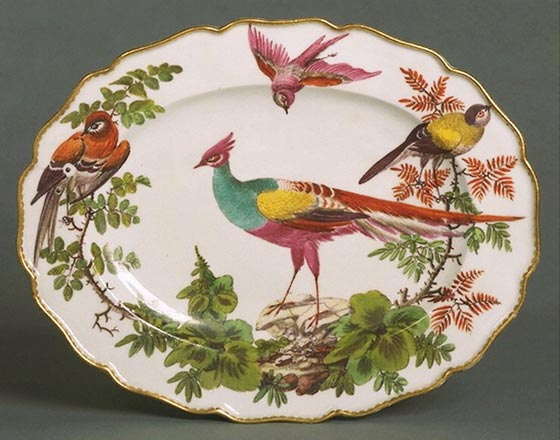
A small Chelsea cup, decorated with a kingfisher on a branch, was offered at Bonhams last March with a presale estimate of seven hundred pounds. The single mark on its underside — a small red anchor, no more than three millimetres tall — pushed the eventual hammer price to eleven thousand.
The Chelsea porcelain factory operated in west London from 1745 to 1769, a span of twenty-four years. In that time it produced some of the finest soft-paste porcelain made in England, and it developed a system of marks that, with patience, allows the modern collector to date a piece to within a decade.
The factory's history divides into four periods, each associated with a distinct mark. The Triangle period, 1745 to about 1750. The Raised Anchor period, 1750 to about 1753. The Red Anchor period, 1753 to about 1758. The Gold Anchor period, 1758 to 1769.
The Triangle period mark is the simplest: a small triangle, usually incised into the base before firing. Triangle-period Chelsea is rare; the factory's output in those years was small, and many pieces have been lost.
The Raised Anchor mark is a small relief anchor, applied to an oval pad of clay set into the base. The pad was added separately to the foot, then the anchor moulded onto it. Raised Anchor pieces are highly sought.
The Red Anchor period produced what most collectors consider Chelsea's finest work. The body is a translucent soft-paste of unusual whiteness, the painting is restrained, and the small red anchor is painted under the glaze in an iron-red enamel.
Red Anchor figures of birds, after engravings by George Edwards in his Natural History of Uncommon Birds (1743 to 1751), are the most celebrated Red Anchor product. The kingfisher cup at Bonhams was one of these.
Gold Anchor pieces, made under the management of Nicholas Sprimont in the factory's last decade, are more ornate. The palette is richer, gilding is heavier, and the forms more elaborate. The gold anchor mark is correspondingly larger and more visible.
Sprimont's health failed in the mid-1760s, and in 1770 the factory was bought by William Duesbury of Derby. Derby continued to use the anchor mark on its own production for some years; the Chelsea-Derby period (1770 to about 1784) produced pieces that carry both an anchor and a D.
Distinguishing genuine Chelsea from Chelsea-Derby — and from outright imitations made by smaller English factories — is the central problem of the field. The body, the glaze, and the quality of the painting are usually the decisive evidence.
Chelsea soft-paste has a slightly granular translucency under strong light. Held to a lamp, a thin section will glow with a warm, slightly yellowish cast. The body of Bow porcelain, the other major London soft-paste factory of the period, has a colder white cast and contains bone ash.
Bow, operating in east London from about 1747 to 1776, was Chelsea's principal English competitor. Its marks are less consistent than Chelsea's. Most Bow pieces are unmarked, and identification rests almost entirely on body and decoration.
When Bow pieces are marked, the mark is often a small painted symbol — an arrow, a dagger, an anchor with a D — added by individual painters rather than by the factory. The painter Thomas Craft, working at Bow in the 1760s, signed with a small initialled T.
Chelsea forgeries are abundant. The red anchor in particular was copied by the Samson firm in Paris from the 1860s onward, often on hard-paste bodies that bear no resemblance to the original soft-paste.
Samson forgeries are usually betrayed by the body. Samson worked in hard-paste, and the resulting porcelain has a brittle, cold feel and a glassy translucency quite unlike the warm Chelsea body.
The Samson anchor is also typically larger and more carefully painted than the genuine Chelsea anchor. The genuine mark is small, often slightly hurried, sometimes off-centre. The forger's anchor is too tidy.
Hester Lloyd notes that the most reliable test for a doubtful Chelsea piece is to handle it. The weight, the temperature, the way the glaze meets the foot rim — these are difficult to forge, and they are also difficult to describe in writing.
A few hours spent in the Victoria and Albert Museum's ceramics study room, where genuine Chelsea pieces can be examined closely, will teach more about the body than any reference book.
The reference books, nonetheless, are necessary. Llewellynn Jewitt's Ceramic Art of Great Britain, first published in 1878 and revised in 1883, remains the foundational work. Bernard Watney's English Blue and White Porcelain of the Eighteenth Century, 1963, is the indispensable companion for blue-and-white pieces.
Watney's chapter on Chelsea is short but precise. He notes the distinguishing characteristics of each period and gives photographs of the marks at full size, which is more useful than the schematic reproductions in most marks books.
The kingfisher cup, after sale at Bonhams, went to a private collection in Hertfordshire. The new owner has not had it valued. He keeps it on an open shelf, and dusts it himself, with a soft brush, on Saturday mornings.