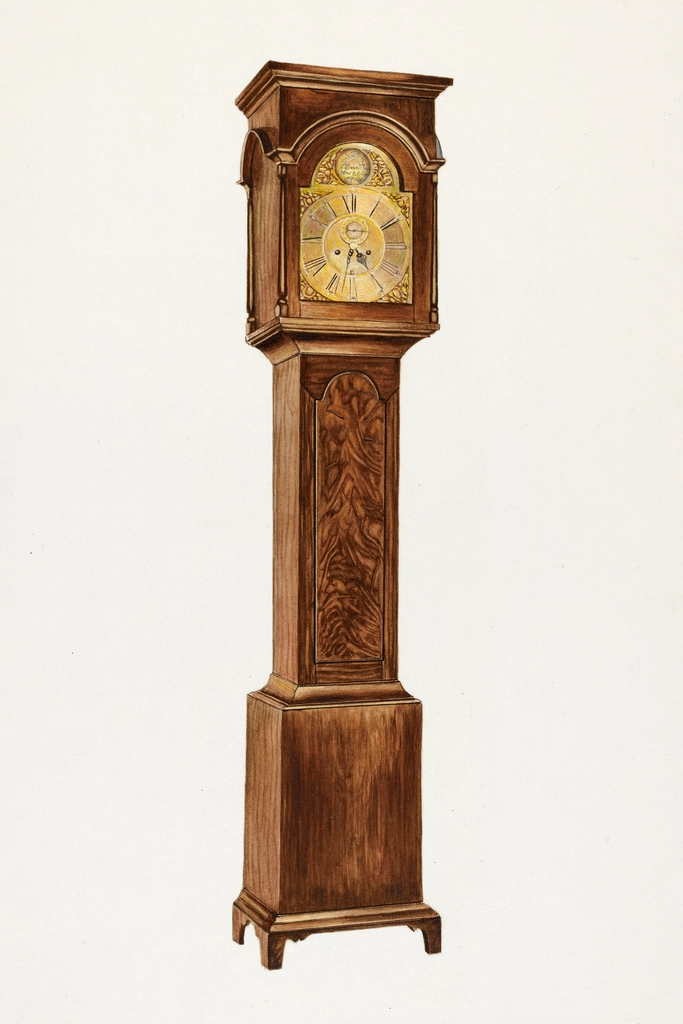
The clock arrived on the morning of December 12, 2025, transported from a private home in Old Lyme, Connecticut, in a custom wooden crate built to accommodate the case standing upright and the movement, pendulum, and weights packed separately.
It is a tall-case clock of the type made in considerable numbers along the Connecticut River valley between roughly 1790 and 1820. The case is cherrywood, the bonnet pediment is a broken-scroll with three brass finials, and the dial is signed in script, in the lower arch, Levi Hutchins, Concord.
Hutchins, a New Hampshire clockmaker who is best known for inventing what is generally credited as the first American mechanical alarm clock in 1787, also made tall-case clocks under his own name from approximately 1785 until 1830. The dial signature is consistent with examples documented in the 1989 catalogue raisonné by Anderson and Whittaker.
The dial is engraved brass with a silvered chapter ring. The movement is an eight-day pull-up weight-driven mechanism with anchor escapement and a verge crutch, of straightforward New England design.
Initial condition: the case had a split running about thirty centimetres up the right side of the trunk, originating at a knot in the cherrywood and opened by humidity cycling over perhaps two centuries. The bellows leather in the strike train had perished. The dial silvering had worn through to brass across most of the chapter ring.
The case split was addressed first. Modern adhesives would have held the joint but would also have prevented future seasonal movement and likely caused a new split elsewhere. The original hide glue was the correct choice.
Hide glue was prepared from dry granules in a small electric glue pot. The split was opened gently with a thin palette knife, the glue introduced with a syringe, the joint clamped with three sash clamps protected by softwood cauls, and the assembly left overnight.
Squeeze-out was cleaned the following morning with a damp cloth before the glue cured fully. The repair is visible on close inspection as a hairline. It will become less visible as the cherrywood continues to darken with age and oxygen exposure.
The movement was removed from the case and taken to a separate bench. The bellows leather, which works the strike mechanism's escapement, was the original c. 1798 calfskin and had dried to the texture of brittle cardboard.
Bellows leather for clock movements is sold by a small number of specialist suppliers. A piece of thin chrome-tanned kidskin was obtained from M. Hewitt & Co. in Birmingham and cut to the original pattern, which had been preserved as a paper template in the workshop's files from a similar Hutchins clock repaired in 2019.
The new leather was glued to the bellows boards with hot hide glue, clamped overnight under a flat weight, and the seams sealed with a thin coat of beeswax dissolved in turpentine. The strike train was reassembled and tested on the bench for forty-eight hours before being returned to the case.
The dial was the most delicate part of the work. The silvering on chapter rings of this period was done by a process called wash silvering, in which a paste of silver chloride, salt, and cream of tartar is rubbed onto the brass and then sealed with a clear lacquer.
Removing the failed silvering and applying new silvering is reversible work but should not be undertaken without serious consideration. The dial signature, the engraved hour numerals, and the patina of the brass would all be at risk during the cleaning required.
The decision, made in consultation with the owner, was to clean the dial with a soft cotton cloth and a small amount of jeweller's rouge, removing the worst of the surface tarnish, and then to apply a thin new wash silvering only to the chapter ring itself.
The work was done by a specialist dial restorer in Newark, New Jersey, named Ada Marchetti, who has been refinishing American clock dials since 1994. The dial was sent on January 14 and returned on March 6, with the chapter ring resilvered and the signature and decorative engraving entirely untouched.
The movement was cleaned in the workshop's ultrasonic tank with a citrate-based watchmaker's cleaning solution. The pivots were polished on a Jacot tool with a soft brass burnisher. The bushings were inspected under a loupe and three were found to be worn beyond tolerance; these were replaced with hand-cut brass bushings of the original interior diameter.
The escapement was adjusted by ear and by eye, with the clock running on the workshop's wall during a two-week regulation period. The rate was within ten seconds per week after the second adjustment, which is well within the tolerance of an eighteenth-century domestic clock.
The pendulum bob was the original lead-filled brass shell of the period. The bob's rate adjustment screw, which had seized, was freed with penetrating oil over forty-eight hours and lightly lubricated with a thin paste of graphite and oil.
The clock was delivered to Old Lyme on April 18, 2026, installed in the front hall of the owner's home, levelled on its plinth with a small spirit level, and started for the first time in twenty-three years. The strike, on the hour, has a slightly tinny quality that is characteristic of bells of this period and was not adjusted.
The owner reports that the clock keeps time within thirty seconds per week and that the strike mechanism, after a brief settling-in period, has become reliable enough to be relied upon for waking purposes. The Hutchins alarm clock of 1787 is, on its own modest scale, still in production.