The serial number stamped into the bed of the machine reads G2,481,553, which places its manufacture, according to the published Singer registers, in the third week of January 1912, at the Elizabethport works in New Jersey.
It came into the workshop on April 2, 2026, accompanied by its owner, a quilter named Esther Tilbrook, who had inherited the machine from her great-aunt in 2018 and had not, in the intervening years, managed to sew a single seam with it.
The Model 27 is a vibrating-shuttle machine, the design Singer manufactured between 1885 and 1913 and the workhorse of millions of American households in the late nineteenth century. It uses a long boat-shaped shuttle rather than the round bobbin of later rotary machines.
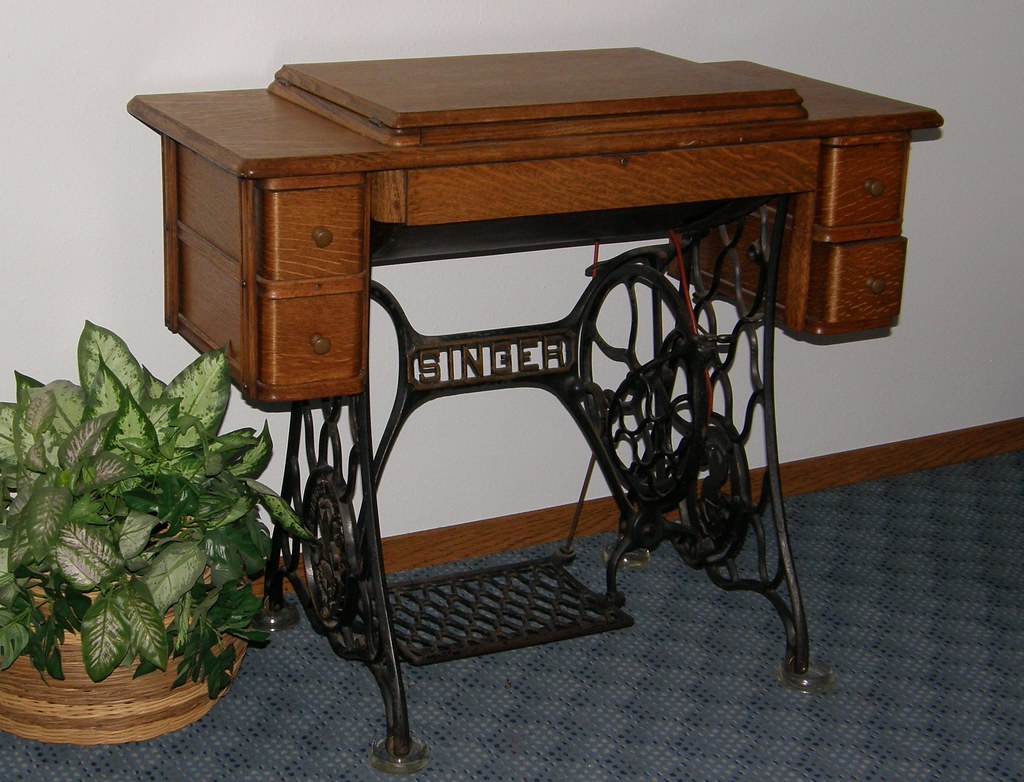
The cabinet is quarter-sawn white oak with a fumed finish, of the type Singer offered as Cabinet No. 5. The cabinet's original cast-iron treadle base was intact, though the rubber-coated foot pedals had perished to powder.
The handwheel would not turn. Application of force only deepened the conviction that something inside was seized.
Diagnosis began with the removal of the slide plate over the shuttle race, which exposed a small rodent's nest of dried cotton thread, wood dust, and what was unmistakably the desiccated body of a moth.
The thread, accumulated over decades of intermittent use without cleaning, had wound itself around the shuttle race and into the lower mechanism. Beneath the thread was a thick brown gum that had once been sewing-machine oil and was now closer to a varnish.
Singer recommended kerosene as a cleaning agent in their original service manuals. The recommendation still works. The lower mechanism was flushed with kerosene applied by a small acid brush, the thread debris extracted with tweezers, and the freed surfaces wiped clean with cotton rags.
The handwheel turned freely after about ninety minutes of patient work. The shuttle, lifted out of its race and cleaned in the same way, proved to be the original 1912 part, marked with the Singer trademark and the part number 8228.
Replacement shuttles are still in production, made by a small workshop in Iowa that supplies the active community of Singer enthusiasts. The original was reusable and the replacement, ordered as insurance, was set aside in the toolkit.
The belt connecting the treadle to the handwheel was a strip of round leather of the correct diameter, joined by a small metal staple. The original belt had stretched, slipped, and finally broken at the staple.
Replacement belting is sold by the metre by at least three suppliers in the United States. A length of two metres was bought from a dealer in Vermont. The new belt was sized by trial against the wheel and joined with a fresh staple.
The bobbin winder, a small spring-loaded mechanism that sits above the handwheel, had a broken thread guide. The replacement guide was filed from a strip of brass shim stock to match the original profile.
The original japanned finish, the glossy black coating Singer applied with a heat-bonded enamel process, was largely intact but dulled by a film of household grime. It was cleaned with a soft cloth dampened with a solution of one teaspoon of dish soap in a litre of warm water.
Sewing-machine japanning of this era is durable but brittle. The cleaning was done in small sections, with the cloth wrung nearly dry, and the surface buffed gently with a second clean cloth. No polish or wax was applied.
The decorative gold pinstripes and the floral decals, which Singer called the Sphinx pattern, were intact across about eighty-five percent of the bed. Touch-up decals are sold by the same Iowa workshop but were not used. Losses to the original decals are a sign of the machine's working history.
The cabinet required less work than the machine itself. The fumed oak finish was cleaned with a soft brush and a vacuum on the lowest setting, then waxed with a clear paste furniture wax.
The cast-iron treadle base was cleaned with a brass wire brush and lightly oiled with a thin coat of camellia oil, which does not gum and does not transfer to fabric.
Tilbrook collected the machine on May 6, 2026. The first test seam, sewn on a scrap of cotton calico with thirty-weight thread, came out even and tight at twelve stitches to the inch.
She sent a photograph in late May showing the machine installed in the corner of her sewing room in Sheffield, beside a window and a small basket of fabric scraps. The cabinet is open. The treadle, she wrote, has a slight squeak on the upstroke that she has decided to keep.