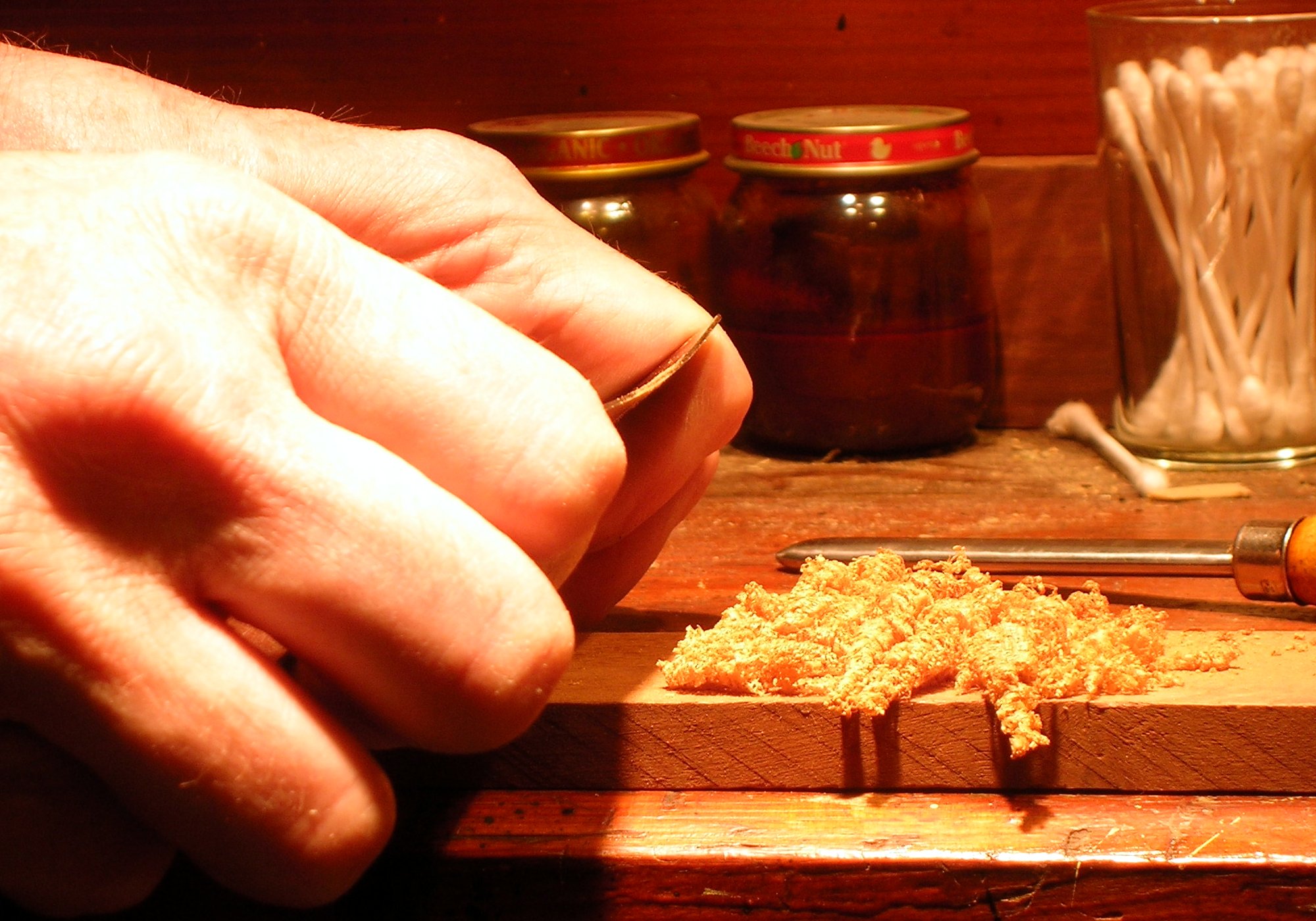
Karl-Heinz Berger keeps a small box of cabinet scrapers on the shelf above his workbench in Berlin-Friedrichshain. There are eleven scrapers in the box, and they are, by some distance, the cheapest tools he owns. He bought most of them, used, from estate sales and house clearances over the last twenty years. None of them cost more than four euros. Three were free.
He uses one or another of them most working days.
A cabinet scraper is, in its plainest form, a rectangle of hardened spring steel about the size of a postcard, perhaps a millimetre thick. There is nothing else to it. No handle, no adjustment, no moving parts. The edge does the work, and the edge, properly prepared, will smooth a hardwood surface to a finish that no sandpaper short of 1500 grit can match.
The catch is that the edge is a small marvel of metallurgy and patience, and almost no woodworker under fifty knows how to produce it.
The scraper's working edge is not, as one might assume, a sharp edge in the conventional sense. It is a tiny, deliberately formed burr — a hook of steel turned over from the squared edge by a hardened tool called a burnisher. The burr is what cuts. The squared edge underneath is its support.
Producing the burr is the work of perhaps three minutes, once a tradesman knows what they are doing. It involves four operations in sequence: filing the edge square, honing it smooth on a fine stone, polishing it on the side faces, and finally rolling the burr with a burnisher held at a slight angle. The whole process can be learned in an afternoon. It usually takes a year to do well.
Berger learned from a Saxon cabinetmaker named Friedrich Hoppe, who was already in his seventies when Berger apprenticed under him in 1992. Hoppe could resharpen a scraper in two minutes flat and produce a finish on quarter-sawn oak that the apprentice spent the rest of his career trying to match.
Hoppe's burnisher was a length of hardened steel rod about the size of a pencil, mounted in a turned beech handle. Berger inherited it when Hoppe died in 2004, and uses it daily. He has tried other burnishers — the carbide rods sold by Lie-Nielsen, the gunsmith's burnishers used by some American restorers — and finds none of them better than Hoppe's old steel.
The scraper's particular usefulness is on figured woods, where a hand plane can lift the grain and sandpaper can leave a dulled, scratched surface. A well-sharpened scraper, drawn across burr walnut or rosewood at the right angle, takes off a translucent shaving the thickness of cigarette paper and leaves behind a surface that catches the light.
For restoration work, the scraper has a second virtue: it removes very little material. A pass with a scraper takes off perhaps a hundredth of a millimetre. A pass with 220-grit sandpaper takes off five times that. On an antique surface, where preserving the original substance is the whole point of the work, the scraper is the only tool that does what is needed without doing too much.
Berger uses scrapers, almost exclusively, for the final surface preparation of restored or replaced veneer. The scraper takes the surface down to a flat, dense finish that accepts shellac or wax without further sanding. The grain is not raised. The dust, of which a scraper produces almost none, does not embed itself in the finish.
The trade in Germany, where the scraper has always been more central to cabinetmaking than in Britain or America, still teaches the tool in apprenticeship programmes. Berger has taken on three apprentices over the years and made all of them sharpen scrapers as one of the first tasks of their training. Two of the three eventually became fluent in the work.
The third, he says, never quite got the burr right. He left for a furniture-making job in Hamburg and, last Berger heard, was sanding everything by machine.
The scraper's main competitor, in any modern workshop, is the random-orbital sander. The sander is faster, requires no skill to use, and produces results acceptable to most clients. It also, in Berger's experience, leaves behind a surface that looks slightly dead — a uniform haze of micro-scratches that catches the light flatly and reads, to a trained eye, as machine-finished.
The scraped surface catches the light differently. It looks polished, in a way that has nothing to do with applied finish, because the grain has been sheared cleanly rather than abraded. Once a restorer sees the difference, Berger says, they do not go back. The trouble is that few restorers learn to see the difference, because they never learn to use the tool that produces it.
Cabinet scrapers cost very little to buy. A new pair from a German or British maker runs about twelve euros. A used one from a house clearance will cost a euro or two. The most expensive scraper in Berger's box, a hand-forged Sheffield piece from about 1890, cost him eight pounds in a Suffolk antique shop in 1998. It is also his best.
The burnisher costs more. A good one, like Hoppe's, can be made by a friendly machinist from a length of tool steel for almost nothing. The commercial burnishers from Lie-Nielsen and Veritas cost between forty and ninety euros and are perfectly adequate.
What costs the most is the time to learn the tool, which is the reason most workshops do not own one.
Berger's advice to anyone curious about scrapers is to buy a single new one from a reputable maker, watch one of the better online videos on burnishing, and spend a Saturday morning on a piece of scrap maple. The first dozen attempts will produce no usable burr. The thirteenth will produce a burr that takes off a shaving. From there, the learning is rapid.
He keeps the eleven scrapers in the box partly out of habit and partly because, when one needs sharpening, he picks up the next one and keeps working. The dull scraper goes back in the box and is resharpened at the end of the day, in a small ritual that takes him about half an hour for the whole set.
It is, he says, the most peaceful half-hour of his working week.