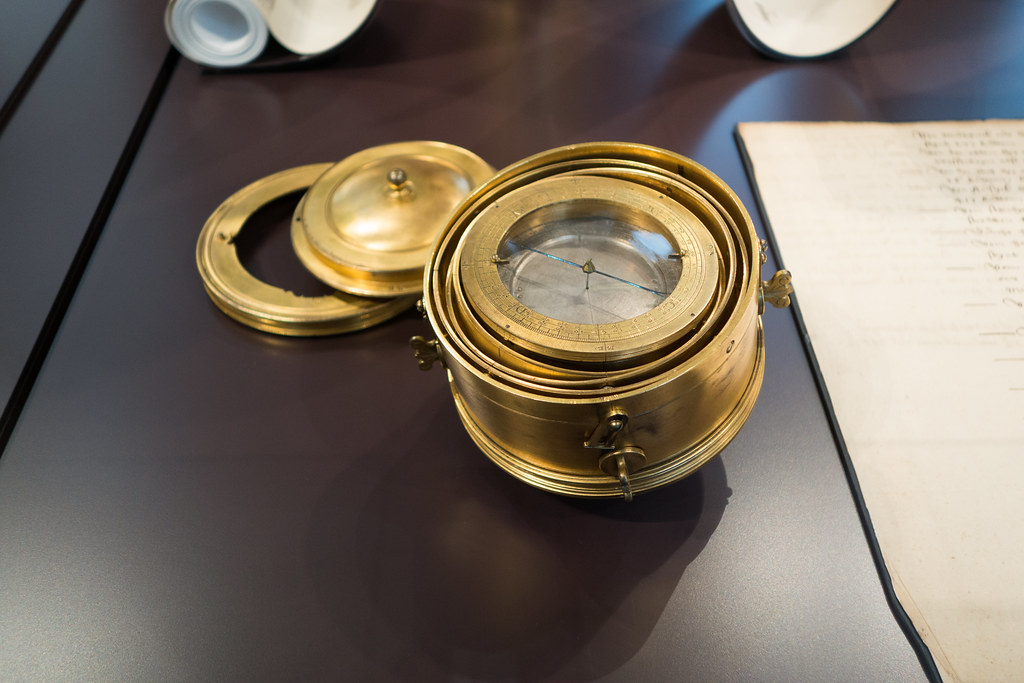
The clock came into the workshop of Walter Pendry in February of this year, brought in by a woman named Cordelia Hauser whose grandfather had captained a coastal schooner out of Provincetown in the 1930s. The clock was a Chelsea Clock Company eight-day ship's bell, with a 6-inch silvered dial, marked on the rear plate with a serial number that put its manufacture in Boston in 1894.
It had not run since 1962. The brass case was almost black with a half-century of marine atmosphere, kitchen vapor, and undisturbed oxidation.
Hauser's request was, in Pendry's recollection, slightly unusual. She did not want the clock made to look new. She wanted it to run again, and she wanted the case cleaned enough that the engraving could be read, but she did not want the patina stripped. She had grown up looking at the clock dark, and the darkness, she said, was part of how the clock looked to her.
This is a more sophisticated request than it sounds. The standard amateur approach to a black brass case is a chemical dip — a commercial product based on dilute acids and chelating agents — that removes oxidation in seconds and produces a uniform bright-brass finish. The result looks new. It is also, from a collector's perspective, often a loss.
Patina on a brass object that has lived for more than a hundred years in a specific environment is, in part, a record of that environment. The dark film is a complex layer of copper oxides, copper carbonates, copper sulfides, and, in marine environments, copper chlorides. It is uneven, it varies in thickness across the object, and the variation tells a quiet story about where the object sat, what it was near, and how it was handled.
Strip the patina, and the story is gone. The object becomes a bright brass case from 1894 that looks indistinguishable from a bright brass case from 2024.
Pendry's method, developed over thirty-two years restoring marine instruments on Cape Cod, is to clean rather than to strip. The distinction is real and is, in his view, the entire ethical question of brass restoration.
He began by disassembling the clock. The movement came out as a single unit. The dial was carefully unscrewed from its bezel and set aside on a velvet pad. The case itself — the bezel, the back plate, the bell, and the mounting flange — was now four separate pieces of brass, all of them dark.
Each piece was first washed in lukewarm water with a small amount of conservation-grade detergent, using a soft natural-bristle brush to remove any loose surface dirt. This step is important and often skipped. Polishing a dirty surface drives the dirt into the metal.
The pieces were dried and inspected. Pendry used a 10x loupe and a strong raking light to identify the high points of the engraving — the Chelsea Clock Company maker's mark, the serial number, the patent dates around the rim — and to note the areas of deepest patina.
His polishing material is a jewelers' rouge, a very fine iron oxide suspended in a wax base, applied with a soft cotton mop attached to a low-speed bench motor. The motor runs at about 1,400 rpm, well below the speed at which a buffing wheel can overheat the metal or smear the surface.
He worked first on the bezel, the most visible part. The mop touched the surface lightly and was kept moving. The goal, he said, was not to remove the dark layer but to thin it, evenly, so that the underlying brass began to glow through. The engraved details were never touched directly with the mop; they were left dark, which made them more legible against the surrounding lighter areas.
The whole bezel took about forty minutes. At the end of it, the brass was the color of a tarnished gold coin — not bright, not new, but warmly metallic, with the engraving cleanly readable in dark relief.
The back plate took longer, perhaps two hours, because Pendry chose to leave the central area considerably darker than the rim, where the original mounting screws had worn the patina away decades ago. The contrast between the darker center and the lighter rim was, he said, what the object actually looked like, and to flatten it would be to lie about the clock's history.
The bell was the most delicate part. Cleaning the bell too aggressively would change its tone. Pendry's method on bells is to clean only the outer surface, never the inner, and to use a still finer rouge applied by hand on a wool felt pad rather than by the mop. He spent an hour on the bell and stopped well before the patina was fully thinned.
After polishing, each piece was washed again in warm water to remove rouge residue, dried thoroughly with a soft cloth, and given a thin coat of microcrystalline wax. The wax — Renaissance Wax, the conservation standard since the 1950s — was applied with a finger and buffed off with a clean cotton cloth. It will keep the patina stable for about ten years before another light application is needed.
The movement was a separate project that occupied the workshop for three more months. Pendry replaced two worn pivots, cleaned the mainspring, replaced a broken click spring, and reassembled the whole. By mid-May the clock was running again, keeping time to within thirty seconds a week.
Hauser came to collect it on the afternoon of May 23rd. She set the clock on the bench, wound it, and listened to the bell strike four bells of the afternoon watch — two pairs of bell strokes, the standard nautical signal for two o'clock.
The clock case was not bright. It was clean, warmly dark, and as it had looked in her grandmother's parlor in the 1950s. Hauser, Pendry told me, did not say anything for a moment. Then she said it sounded exactly right.
The clock is now in her house in Wellfleet, on a shelf above the bookcase in the south room, where the morning light catches it. It strikes four bells and eight bells through the day, and Hauser winds it on Sunday morning, which was the day her grandmother wound it. The patina, with the wax to slow it, will outlast her.