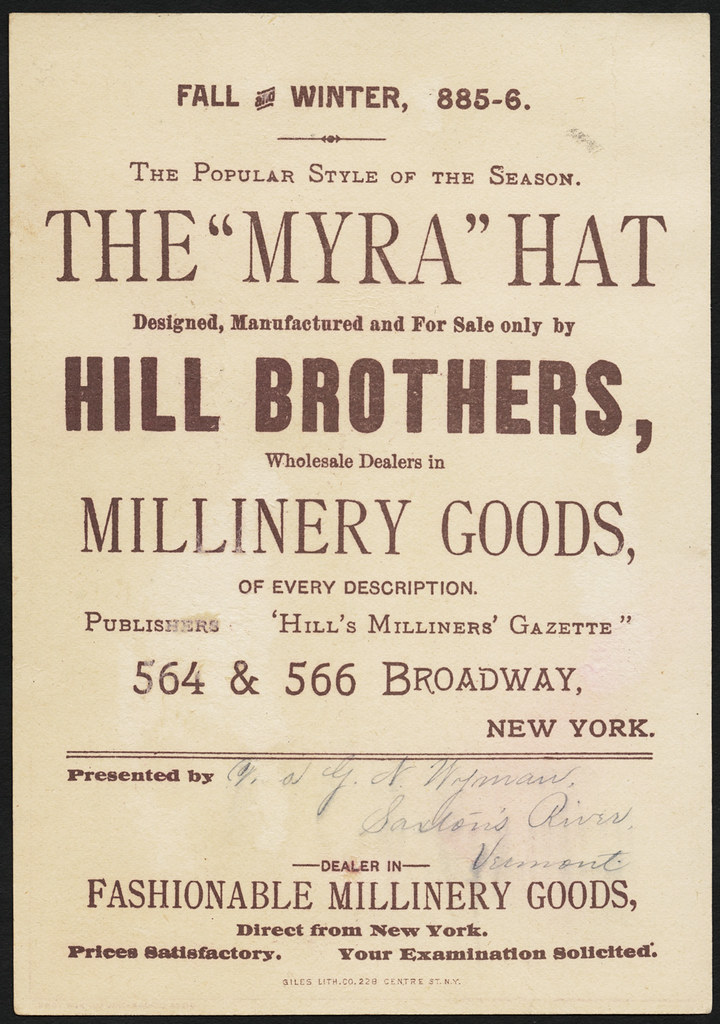
Henry Carmichael lives in a third-floor walk-up apartment in the Logan Square neighborhood of Chicago. He has lived there since 1988. The apartment has two rooms, a kitchen, and a deep linen closet. The trade cards live in the linen closet.
The collection numbers 6,318 American trade cards, almost all chromolithographic, almost all dating between 1880 and 1905. Carmichael does not collect English, German, or French trade cards, and he does not collect the later twentieth-century advertising cards that survived the chromolithography era.
His draws his boundaries narrowly on purpose. He is interested specifically in the period when American printing reached its first technical peak — the moment, he says, when a small Chicago grocer could buy a thousand cards of museum-quality color printing for the cost of a week's wages for a clerk.
The cards are stored in 84 archival boxes, each box holding 75 cards in acid-free interleaving. Carmichael built the storage system in 1996 with the help of a paper conservator named Margaret Yi at the Newberry Library.
The boxes are organized by industry, then by manufacturer. The largest category is sewing thread, of which Carmichael has 612 cards, mostly from the J&P Coats and the Clark's O.N.T. companies of the 1880s and 1890s.
The second-largest category is shoe blacking and boot polish, with 487 cards. The third is patent medicines, with 412.
He has a complete run of the Arbuckle Brothers Coffee map series of 1889, all fifty cards in fine condition. He has the Singer Sewing Machine national-costumes series of 1892, of which he has 39 of the 40.
The missing Singer card, the one representing Persia, has eluded him for twenty-three years. He has bid on three at auction and lost each time. He has not raised his maximum bid in eleven years. He says the card will come when it comes.
Carmichael began collecting in 1979, when he was a young graphic designer at a Chicago advertising agency and bought a single Higgins Soap card at a Hyde Park yard sale for ten cents. He was twenty-six.
He bought slowly through the 1980s. He bought more steadily through the 1990s, when prices for trade cards remained low and the supply at small auctions and flea markets was abundant.
He estimates he has spent, across forty-seven years, between forty-seven thousand and fifty thousand dollars on the collection. He has never sold a card.
His method has shifted over the years from in-person flea-market buying to mail-order from three specialty ephemera dealers, two in New England and one in Pennsylvania. He has not been to a flea market since 2019.
He catalogues each card by hand on a 3-by-5 card filed in a small wooden cabinet built by his grandfather, a Detroit cabinetmaker, in 1923. The cabinet has eight drawers. Each drawer holds about a thousand cards.
The catalogue is the same age, almost exactly, as the cards, Carmichael said. I like the symmetry.
He records the manufacturer, the printer if identifiable, the subject, the apparent date, the source, and the price. He does not record condition in detail because, he says, his collection is selected for condition at the moment of acquisition.
He does not buy cards with foxing, edge wear beyond minor, or any sign of paste residue on the back. He says the discipline of refusing damaged cards has shaped the collection more than any other single decision.
Carmichael keeps a small selection of about fifty cards on rotating display in two oak frames on the wall above his desk. He changes the cards once a month. The framing is by a conservator at the Art Institute of Chicago, with UV-filtering glass and reversible mounts.
He does not consider the framed cards displayed in the collector's sense. He calls them his desk reading. He looks up at them while he works.
The cards were made to be looked at, he said. Not all at once. One at a time. That is what I do.
Carmichael is seventy-three. He retired from graphic design in 2018. He spends about fifteen hours a week on the collection now, mostly cataloguing, occasionally hunting for the missing Singer Persia.
He has arranged for the collection to go to the Newberry Library's ephemera collection on his death. The arrangement was finalized in February 2025. The Newberry has agreed to keep the cards together as a single named donation and to maintain the box-and-drawer organization Carmichael built.
The Newberry is fifteen blocks from this apartment, he said. The cards will travel a short distance. That seems right for cards that were never intended to travel far in the first place.