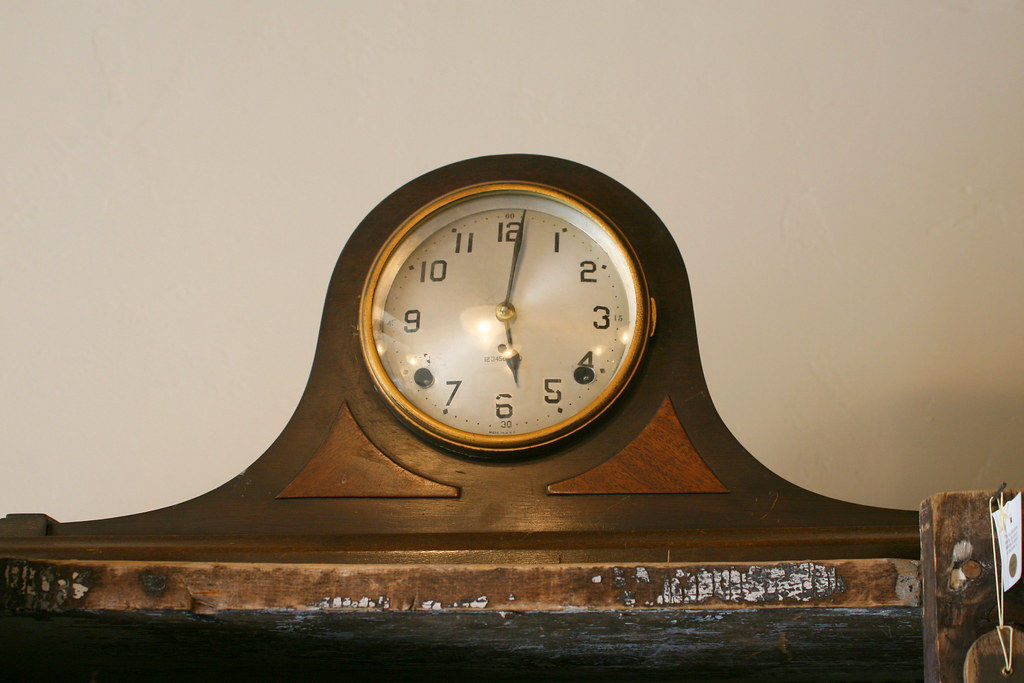
The Hartwell Clock Auctions spring sale was held on June 6, 2026, in a converted mill building in Marlborough, Massachusetts, with one hundred and eighty-four lots of American and English clocks offered between one and six in the afternoon.
Hartwell is a specialist house. They sell only clocks, watches, and related horological material, four times a year, from the same Marlborough premises since 1994. The buyers are largely the same hundred and twenty people from sale to sale.
The single-discipline auction is a particular kind of market. The depth of knowledge in the room is uniform and considerable. The catalogue is, in effect, a working census of a particular subset of the discipline. The bidding is sharp and the post-sale conversation is technical.
A Pewter correspondent attended on assignment with this magazine, having spent twelve years restoring clocks in Berlin Neukölln before turning to writing. The point of the visit was to observe how a specialist sale differs, in practice, from a general decorative arts sale.
The viewing began at ten in the morning on the day of the sale. The clocks had been arranged along three long tables and against the perimeter walls of the gallery. The tall-case clocks, of which there were twenty-three, stood in two rows along the south wall, each with a small card identifying the lot number and the maker.
The view at a specialist sale is differently used than the view at a general sale. The buyers do not simply look at the cases. They open the trunks, examine the movements, count the wheels, inspect the dials for the faint marks of replacement hands, lift the weights, listen to the strike.
Lot 28 was a Massachusetts tall-case clock by Simon Willard, the case attributed to a Boston cabinetmaker working circa 1795, the eight-day brass movement signed on the dial, with original moon-phase indication, in apparent original condition. Estimate twenty-eight thousand to forty-two thousand dollars.
A correspondent watched four serious bidders examine the Willard during the viewing. Each spent between fifteen and twenty-five minutes with it. One bidder, a dealer from Newburyport, removed the dial entirely to examine the back, with the porter's permission, and replaced it carefully.
The Willard sold at the rostrum at three-fifteen for fifty-six thousand dollars to a private collector from Connecticut, with bidding contested between three phones and two paddles in the room. The applause was specifically for the maker.
Simon Willard, working in Roxbury, Massachusetts, between roughly 1780 and 1839, made approximately four thousand clocks in his lifetime, of which perhaps a thousand survive. The catalogue documentation for the clock at lot 28 traced the family ownership back to 1812.
Lot 47 was an English bracket clock by Thomas Tompion of London, circa 1690, with the original engraved brass back plate signed and numbered 217, in a later (probably 19th-century) ebonised case, the movement complete and in working order. Estimate forty thousand to sixty thousand dollars.
The Tompion would have been the lot of the day at almost any general decorative arts sale. At Hartwell it was one of several important pieces and the room understood its place. It sold for eighty-eight thousand dollars to a London dealer bidding on the phone.
Tompion is the most studied of all English clockmakers. The numbered series of his bracket clocks has been catalogued in considerable detail. The piece at lot 47 was already known in the literature, with three published references in the catalogue. The reference base lifted the price by perhaps fifteen percent over an otherwise comparable but undocumented piece.
Lot 62 was a small group of three American shelf clocks by Eli Terry of Plymouth, Connecticut, circa 1820 to 1825, all with wooden movements, two in original condition, one with a replaced dial. Estimate fifteen hundred to twenty-two hundred dollars for the group. Sold for two thousand eight hundred to a dealer from Plymouth, Connecticut, the maker's home town.
Wooden-movement Terry clocks are the form for which the maker is best known. They were mass-produced in their day and remain common today, but a good original example, with original dial and original hands, is a serious piece. The dealer from Plymouth had bought four similar clocks at the previous Hartwell sale.
The catalogue for a Hartwell sale functions, over time, as a working census of the surviving examples of certain forms. A scholar studying the Terry shelf-clock production can trace a substantial percentage of known examples through the Hartwell sale records of the past three decades.
This is one of the under-appreciated functions of a specialist auction house. The catalogues, taken together, constitute a primary research archive. A correspondent from this magazine has Hartwell catalogues going back to 1996. They live on the shelf above the workbench in a Berlin studio.
Lot 109 was a French gilt-bronze and porcelain mantel clock, mid-19th century, the movement by Japy Frères of Beaucourt, the case attributed to a Parisian bronzier, in working order, with original key. Estimate fifteen hundred to twenty-two hundred dollars. Sold for twenty-six hundred to a private collector in the room.
French mantel clocks of this period are not the Hartwell house specialty, and the pricing reflects it. A piece of the same caliber would sell, in Paris, for twenty to thirty percent more.
Lot 144 was a long-case regulator clock by John Arnold of London, with a mercury-compensated pendulum and dead-beat escapement, in a plain mahogany case, circa 1810, in apparent original condition. Estimate eighteen thousand to twenty-four thousand. Sold for thirty-one thousand.
Arnold regulators were used in observatories, in the workshops of other clockmakers, and by private astronomers. The piece at lot 144 had a documented period of use at a small private observatory near Bristol in the second quarter of the 19th century. The provenance, fully documented in the catalogue, added measurably to the price.
The sale closed at five-fifty. The buyers gathered, as they do at the end of every Hartwell sale, in the front entry of the mill building for thirty or forty minutes of conversation. The talk was largely technical — escapements, plate engravings, the recent restoration of a particular Boston tall-case, the question of whether a certain Newburyport maker had ever made a true grandfather clock or only the tall regulator form.
A specialist sale of this kind is, for a collector new to the discipline, the single best educational opportunity available. The pre-sale viewing alone is worth the drive. A buyer who has no intention of bidding will still come away with a working knowledge of the field that several hours of book reading could not provide.