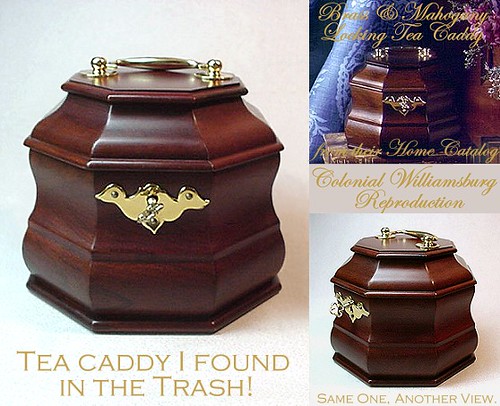
The tea caddy is mahogany, sarcophagus-shaped, with crossbanded satinwood inlay around the lid and a small silver-plated escutcheon for the key. It measures eight inches wide, four and three-quarter inches deep, and five inches tall to the apex of the lid. Inside are two compartments lined with lead foil, one for green tea and one for black, and a small central mixing bowl of cut glass.
The caddy was bought by a Sevenoaks dealer named Geoffrey Marland at a country house sale in Headcorn, Kent, in February 2026. It was lot 219 in a sale of the contents of a small Georgian rectory whose last owner had died at ninety-six. Marland paid £140 for it.
Marland brought it to a London colleague named Harriet Pickford, who in turn brought it to The Pewter. Cyrus Peake in Sheffield agreed to look at the caddy in March.
The caddy is in good but not exceptional condition. The lid hinge has been replaced, probably in the 1920s, with a brass hinge of slightly later pattern than the original. The lead foil in the green-tea compartment has corroded around the edges. The mixing bowl is original and uncracked. The escutcheon is original silver plate on copper, slightly worn through to the copper on the right edge.
What made Peake reach for his magnifier was a small mark stamped into the underside of the lid, set just inside the hinge so that it is visible only when the lid is fully open. The mark is an oval, no more than seven millimetres long, containing the letters LCH and the date 1786. Below the oval is a tiny crown.
LCH is the abbreviation used by the London Custom House for goods inspected and stamped at the Pool of London. The crown indicates the inspection took place at the King's Beam, the central customs warehouse on Lower Thames Street. The date 1786 is the year of inspection. The mark is rare; customs marks on small wooden goods of this period were stamped only on items containing dutiable contents at the time of import or first sale.
Tea caddies were not, in themselves, dutiable. What was dutiable was the tea inside them. The mark indicates that this caddy was sold full, with tea included, and that the duty on the tea had been paid at the Pool of London in 1786.
A small number of London cabinetmakers sold tea caddies pre-filled with tea, on commission for tea merchants who wanted to offer a luxury domestic product. The practice was uncommon and the documentation is thin, but Peake remembered a reference in the trade records of Twinings of the Strand to a 1786 promotional arrangement with a cabinetmaker named Henry Holland of Newman Street.
Holland is not the more famous architect Henry Holland; he is a journeyman cabinetmaker who worked briefly in the orbit of the Adam brothers and is documented in the London trade directories from 1779 to 1791. Holland's surviving daybook for 1786, held in the manuscripts collection of the Victoria and Albert Museum, lists, on April 19 of that year, a delivery of six tea cases of best mahogany, with silver mounts, lead-lined, to Mr. Twining of the Strand, £4 4s. each, with tea to the value of £2 12s. paid separate.
Twinings' own ledger, held at the company archive in Andover, records six caddies received from Holland on April 22, 1786, and sold over the following two years to six named customers. The sixth customer, who bought his caddy on November 11, 1787, was a linen-draper named Josiah Mannering of Cheapside.
Mannering kept a household daybook, which survives in the collection of the Guildhall Library in London. The entry for November 11, 1787, reads paid Twining of the Strand for a tea case of mahogany with tea, £6 16s., delivered to the house.
Six caddies were ordered; six were sold; the prices and dates all match. The caddy in Sevenoaks is one of the six, and the customs mark, the Holland-Twinings provenance, and the Mannering purchase together place it in a single household on a single date in November 1787.
From Mannering the caddy descended through three generations of his family until 1872, when a Mannering granddaughter married a Kent clergyman and moved to a rectory in Headcorn. The caddy went with her. It remained in the rectory for 154 years.
The rectory's last occupant was a Mannering descendant in the female line named Edith Calver, who died in October 2025 at the age of ninety-six. She had used the caddy on her own breakfast tray for sixty years. Her tea was Twinings English Breakfast, decanted from a paper packet into the green-tea compartment, the original purpose of the compartment having been forgotten somewhere in the late nineteenth century.
Peake's research adds three documented owners — Mannering, the Kent clergyman, and Edith Calver — to a caddy whose original sale was already documented in two separate archives. The result is a complete provenance from the date of customs inspection in April 1786 to the date of sale in February 2026: 240 years, six named hands.
Marland, the dealer, has revised his asking price. The caddy was offered at £600 before Peake's research and is now offered at £4,200. The increase reflects not the object itself, which is unchanged, but the documentation that now travels with it.
Peake has recommended that the caddy be sold with a typed provenance summary attached to the underside of the lid, on archival paper, with a small reference to the Twinings ledger and the Mannering daybook. The buyer is welcome to remove the paper, but Peake's experience is that buyers who pay for provenance tend to keep it.
The hinge will not be replaced again. The lead foil will not be cleaned. The mixing bowl will stay in the central well, where it has been since November 1787. The caddy is going to a private collector in Hampshire who has agreed to use it, on a breakfast tray, for tea.